Digital marketing is evolving faster than ever, especially in AI ad optimization. In the past, advertising meant manually selecting audiences, setting up a few ads, and gradually optimizing campaigns based on performance.
Today, advertisers face a different reality: AI plays a significant role in content distribution, audience evaluation, and performance measurement.
In this new environment, AI ad optimization becomes the foundation of successful campaigns.
It is no longer about how much we spend, but about how well we enable the algorithm to understand our goal and choose the best path to achieve it.
That is precisely why AI digital advertising is becoming a key competitive advantage for modern brands.
What Does AI Ad Optimization Actually Mean?
AI ad optimization is the process of structuring and adjusting campaigns so that artificial intelligence systems can:
- understand the campaign objective
- identify relevant audiences
- learn from user behavior
- automatically improve results
In other words, the goal is not to hand everything over to the algorithm, but to collaborate with it strategically. AI cannot guess your message, product value, or brand identity, but it can make highly efficient decisions about who should see your message, when, and where.
If you are wondering how AI improves advertising, the answer is simple: it learns from data and continuously optimizes decisions to increase campaign relevance and performance.
Why Is AI Optimization Essential Today?
The reasons are practical and highly specific.
Users leave digital footprints through hundreds of micro-interactions — searches, clicks, video views, and website visits.
AI systems can analyze these signals in real time and identify the moment when a user is most likely to decide.
Automated testing enables faster learning. Instead of manually comparing ad variations, the system automatically tests dozens of combinations and reallocates budget where it delivers the highest value.
This is the core answer to how to optimize campaigns with AI — through continuous learning and automatic strategy adjustments based on audience behavior.

How Does AI “View” Your Ads?
Unlike traditional advertising, which relied heavily on human judgment, AI digital advertising is data-driven. AI systems analyze dozens of elements, including:
- message relevance
- clarity of campaign objectives
- performance of visuals and headlines
- post-click user behavior
- landing page quality and context
- conversion signals (e.g., scroll, click, add to cart, inquiry)
If a campaign lacks a clear structure and properly configured signals, AI does not know what to optimize for.
The result?
Budget spending without the desired impact.
Google AI Max and Ads Advisor: How AI Supports Campaign Management
Google has started integrating advanced AI tools directly into its advertising ecosystem.
One of the newest features is AI Max for Search campaigns, a beta option that enables Google’s AI system to automatically optimize keywords, ad variations, and landing pages according to user intent.
What Is AI Max?
AI Max is an advanced AI-driven approach to managing and optimizing Search campaigns that:
- expands keyword coverage and identifies broader search themes
- automatically creates and tests ad variations
- connects data from landing pages, feeds, and assets
- adapts ads to user intent in real time

In short, it provides the algorithm with enough data to independently identify the most valuable audience and increase conversions at a similar cost.
What Does Ads Advisor Do?
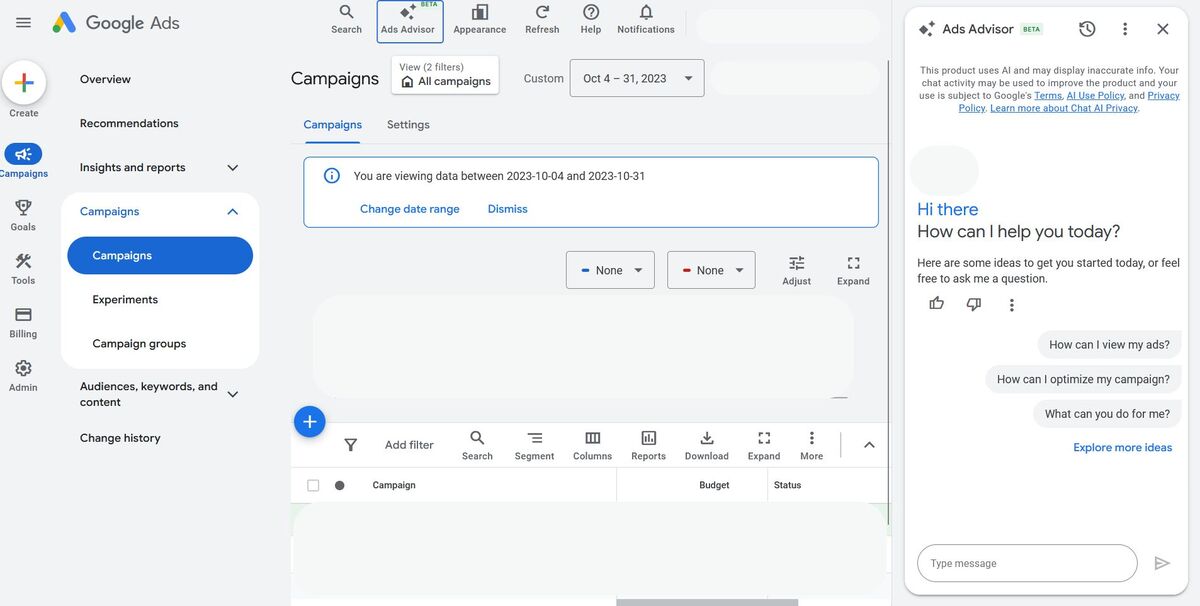
Instead of the traditional click-and-search approach, there is now an AI assistant built directly into the Google Ads interface.
Ads Advisor:
- explains campaign performance
- suggests optimizations and new ideas
- helps identify issues and missed opportunities
- guides campaign setup and improvements
- answers questions in real time (chat interface)
It looks and behaves like a personal Google Ads consultant within your account.
What Does This Look Like in Practice?
Example interactions:
“How can I improve my campaign?”
→ Ads Advisor suggests optimizations (new ads, stronger signals, audience segments…)
“Which keywords are wasting budget?”
→ Highlights low-performing keywords and recommends removal
“Show me top performing assets.”
→ Reveals which headlines, descriptions, and visuals contribute most to results
Together, these tools mark the beginning of an era where advertisers do not just use AI — they actively collaborate with it to manage and improve campaigns.
Conclusion
AI ad optimization is not a passing trend — it is the new standard.
Platforms increasingly manage decision-making processes, while the advertiser’s role shifts from manual control to strategic guidance and ensuring high-quality content, signals, and structure.
Those who adapt will increase efficiency and improve results with the same or even lower budget. Those who rely on outdated methods risk becoming invisible.
Do not wait for your competitors to move first — contact us and leverage the benefits of AI advertising in Croatia.